Tag: motivation

  • Some Seasons of Life Are Meant to Be Slow

    Not every season of your life is designed to feel exciting or fast-paced. Some periods will naturally feel quiet, filled with months spent simply trying to figure things out, working hard without seeing immediate, flashy results. In those moments, it is dangerously easy to fall into the trap of thinking you are falling behind. But slow does not mean stuck.

    A peaceful morning landscape with a cat, symbolizing patience, healing, and embracing slow seasons of growth

    Growth Doesn’t Always Look Like Progress

    We tend to measure progress by visible milestones: a new job, a bigger paycheck, a finished project, or a major external achievement. Yet, some of the most profound growth happens entirely out of sight.

    Learning to trust yourself, recovering from disappointment, building patience, understanding your personal boundaries, and changing the harsh way you speak to your inner self may not look impressive on paper, but they shape who you become.

    Some Things Simply Need Time

    You cannot rush everything into existence. A seed does not become a tree overnight, and meaningful skills or relationships require repetition, experience, and time. Forcing the process doesn’t accelerate the outcome; it often just makes the journey unnecessarily exhausting.

    You Don’t Have to Be Productive Every Minute

    There is an exhausting modern pressure to make every single moment count—to learn, build, exercise, and optimize endlessly. But humans are not machines. There are days when your greatest victory is simply getting through the hours, and afternoons where doing less is an absolute necessity. Rest and quiet are never wasted time; they are the space where you finally get to hear your own thoughts again.

    Stop Comparing Your Pace

    Someone else may be moving at a faster speed or ticking off goals before you do. That does not mean you need to panic or rush. Their timeline is never your deadline, and your life carries its own unique circumstances, lessons, and timing.

    Let slow days be slow, trust the invisible progress happening beneath the surface, and remember that a quieter season is still an essential, beautiful part of your story.

  • You Can Don’t Have to Feel Ready

    How many times have you caught yourself saying, “I’ll start as soon as I’m finally ready”? We tell ourselves we need to feel more confident, know enough, have endless free time, or feel completely fearless before we take a single step. It always sounds like a very reasonable approach. But most of the time, waiting to feel ready is simply a clever disguise for staying stuck in our comfort zones.

    A peaceful morning view symbolizing the journey of starting without feeling ready

    Ready Is Not a Prerequisite

    We tend to assume that confidence comes first. We think we need to feel secure and sure of ourselves, and only then take action. In reality, life rarely operates that way.

    More often than not, you take the first step while you are still deeply uncertain. You try, you stumble, you make mistakes, and you learn along the way. Only then does true confidence begin to form. You don’t become ready and then begin; you begin, and becoming ready happens organically as you move forward.

    Fear Is Just a Sign That It Matters

    Feeling nervous or scared doesn’t automatically mean you are making the wrong choice. Sometimes, it simply means that whatever you are about to do actually matters to you.

    Starting a new project, changing your daily routine, or stepping into the unknown will always feel uncomfortable. You don’t need to completely eliminate fear before moving forward. Real courage isn’t the total absence of uncertainty—it is choosing to take the step anyway, even while your hands are shaking a little bit.

    Your First Attempt Is Allowed to Be Messy

    We often delay starting because we want everything to be flawless right out of the gate. We want the perfect plan, perfect timing, and a polished version of ourselves. But your first attempt doesn’t need to impress anyone; it only needs to exist.

    Write that rough first paragraph, record the imperfect video, or take that small initial walk. Your first draft or version is always allowed to be unfinished. After all, you can easily improve something that actually exists in front of you, but you can never improve something you never begin.

    Action Teaches You What Planning Cannot

    Thinking and preparing can only take you so far. You can research for weeks, map out endless scenarios, and try to anticipate every obstacle. Eventually, however, you have to experience the thing itself.

    Action gives you raw data that planning never can. You discover what genuinely works, what needs to change, and what you actually enjoy. Sometimes, the path forward only becomes visible after you take the very first step.

    Stop Waiting for Permission

    You don’t need everyone around you to completely understand your vision or agree with your choices. You don’t need a stamp of approval to prove you are capable. If a path or an idea matters to you, you have full permission to explore it, to stumble as a beginner, and even to change your mind later on.

    When things feel overwhelming, scale the goal down. Don’t ask yourself how you are going to completely overhaul your life overnight. Just ask what tiny, manageable action you can take in the next ten minutes.

    You don’t need the entire roadmap mapped out to make progress. You just need the next step. Let yourself be imperfect, let yourself learn, and remember: the feeling of readiness you’ve been waiting for doesn’t arrive before you start—it shows up because you finally decided to begin.

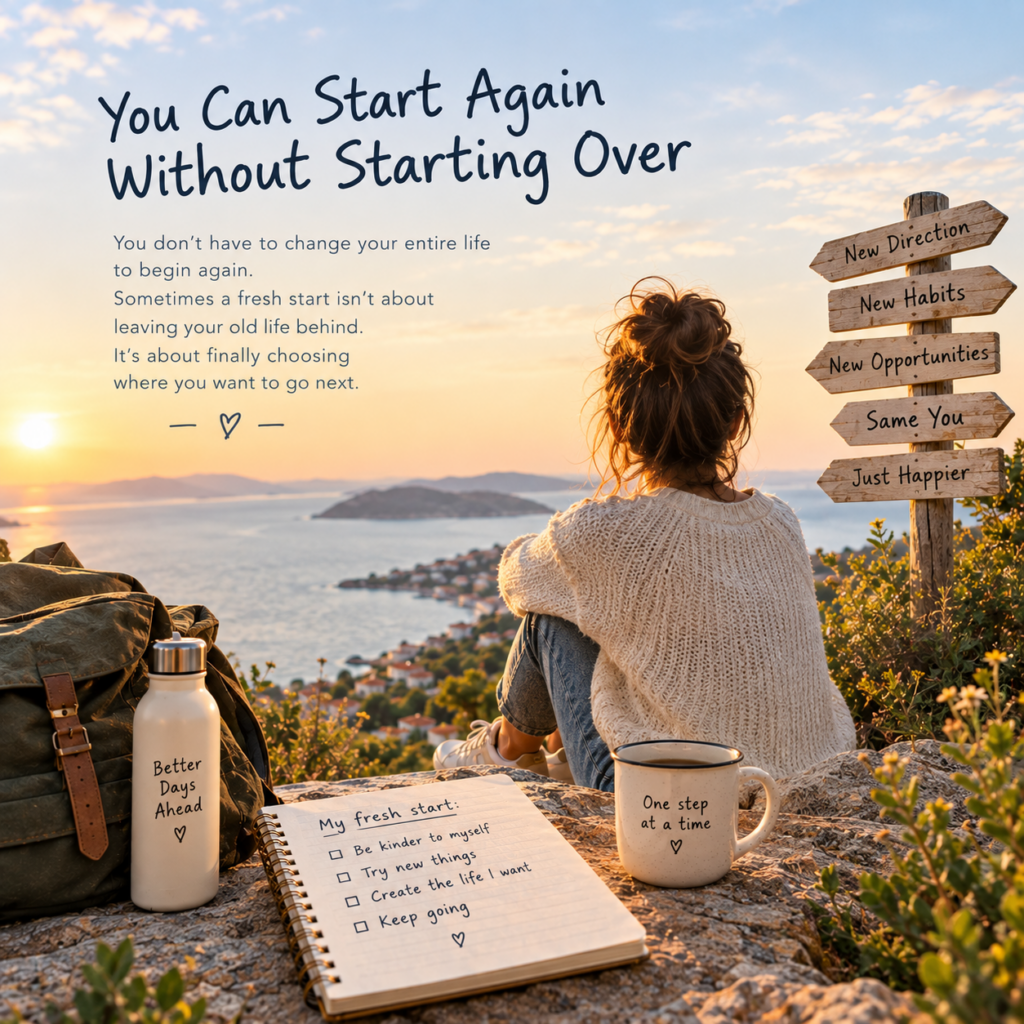
  • You Can Start Again Without Starting Over

    Sometimes, life pushes you to a point where you feel like the only way forward is to burn everything down and completely start over from scratch. You catch yourself dreaming of a new job, a brand-new city, a totally different daily routine, or even an entirely new version of your own personality. You look at the mirror and think, “Maybe I just need to change everything about my life.”

    You Can Start Again Without Starting Over concept illustration
    You Can Start Again Without Starting Over concept illustration

    It’s a heavy, overwhelming feeling. But the truth is, most of the time you don’t need a completely new life. You just need a slight change in direction.

    You Are Not Starting From Zero

    When a project, a relationship, or a phase of life doesn’t work out the way you hoped, it’s easy to look back and feel like all that time was simply wasted. But it never is. Every single experience taught you something valuable. Every mistake handed you a piece of data, and every difficult, draining season revealed a layer of inner strength you didn’t know you had.

    Even the paths you wish you had never walked are part of the map that brought you right here. Starting over doesn’t mean erasing your past or pretending it never happened. It simply means taking everything you’ve learned along the way and carrying it forward. You are not starting from zero; you are starting from experience.

    You Are Allowed to Change Your Mind

    We often trap ourselves because we feel chained to decisions we made years ago. You don’t have to stay permanently committed to a version of yourself, a career path, or a lifestyle that no longer fits who you are today. Maybe you chased a certain dream because it felt right at twenty-one, but now at thirty, it feels completely hollow.

    Changing your mind isn’t a badge of failure. More often than not, it is the loudest proof of your personal growth. You are fully allowed to discover that you want something entirely different out of your brief time here.

    Clarity Arrives After You Move

    One of the main reasons starting over feels so terrifying is our desperate need for a master plan. We want the entire roadmap laid out before us—we want to know where we’ll be in five years, what the risks are, and if we’ll succeed.

    The catch, however, is that clarity almost never comes from sitting still and overthinking. It comes from movement. You don’t need to map out your entire next decade today; you only need to figure out what feels like the right next step. Send that email, update your resume, buy the notebook, or take a walk to clear your head. Small, physical actions create a momentum of clarity that thinking alone can never reach.

    Real Change Can Be Quiet

    Starting over doesn’t require a cinematic, dramatic transformation. You don’t need a new personality, and you certainly don’t need to suddenly become a fearless, hyper-productive machine overnight.

    Real, lasting change is often remarkably quiet. It looks like becoming a bit more honest about what drains your energy. It looks like protecting your free time, learning how to say no without making excuses, and giving yourself permission to be a complete beginner at something new.

    Choosing Where You Go Next

    Maybe you made a choice you regret. Maybe you stayed in an unfulfilling situation way longer than you should have, or maybe you lost your compass for a while. None of that stops you from beginning again right now. You don’t need anyone’s permission, and you don’t owe an explanation to your past self or anyone else.

    You can simply look at your messy, beautiful life today and decide that this isn’t where your story ends. You don’t have to throw everything away to find a fresh start. Sometimes, starting over isn’t about leaving your old life behind at all—it’s about finally choosing where you want to go next.

  • You Don’t Have to Change Everything at Once

    Sometimes we take a hard look at our lives and suddenly want to fix everything all at once. We want to work out more, eat cleaner, read every night, save money, sleep earlier, chase our dreams, and stop staring at our phones. The list just keeps growing.

    A few days later, we are completely burnt out. The pace becomes unsustainable, and we end up dropping everything out of sheer exhaustion. Most of us blame our lack of discipline when this happens. But the real problem isn’t your willpower; it’s simply that you’re trying to carry too much on your shoulders at the exact same time.

    Start Small

    You don’t need to completely overhaul your life by tomorrow morning. You really don’t. You can just start with one tiny step. Drink an extra glass of water, go for a short ten-minute walk, put your phone away for fifteen minutes, or just get to bed ten minutes earlier tonight.

    At first, these small actions might feel almost pointless. You might catch yourself thinking, “What difference is this even going to make?” But that is where the real magic happens. Small, repeated actions quietly pile up over time like a snowball rolling down a hill.

    Action Creates Motivation

    We usually sit around waiting for that massive wave of motivation to hit before we finally decide to start something. We tell ourselves we’ll wait for the right moment, for Monday to roll around, or until things finally calm down.

    Except motivation doesn’t always show up first. In fact, action is often what creates motivation in the first place. You take one small step, and suddenly the second step feels a bit easier. Before you know it, the engine is running and the wheels are turning. You don’t need to feel inspired; you just need to get moving.

    Make the First Step Ridiculously Easy

    If a new habit feels intimidating, your goal is probably too big. Want to read more? Don’t pressure yourself to finish a whole chapter. Just read a single page. Want to exercise? Forget the hour-long gym session and just stretch for five minutes.

    The point isn’t to impress anyone. The point is to lower the barrier to entry so your brain doesn’t put up a fight. Once you sit down and actually begin, keeping going becomes much easier.

    Real Progress is Quiet

    The most lasting changes in life usually arrive without making any noise. You might not notice the shift from one day to the next, but if you look back a few weeks later, something feels different. You’re sleeping a little better, your mind feels clearer, your screen time has dropped, and you trust yourself just a bit more.

    Progress doesn’t always have to look impressive from the outside. It just has to nudge you a little closer to where you actually want to be.

    Give Yourself Permission to Be a Beginner

    If you want to get good at something new, you have to be willing to be bad at it first. It is completely okay to start slowly, make mistakes, change your mind along the way, or even start over. Being a beginner isn’t embarrassing—it’s concrete proof that you are willing to grow.

    You don’t have to fix your entire life today. Just pick one thing. One tiny action, one small improvement. Let that be enough for now. Tomorrow, you can take another step. That’s how real paths are built.

  • 🌿 The Courage to Begin

    Every journey starts with a single step. Learn why taking action—even when afraid or unprepared—is the key to progress and personal growth.


    #courage #growth #mindset #motivation #dailyinspiration


    Starting Is the Hardest Part

    Often, the hardest step in any journey is the first one.
    We wait for the perfect moment, the right plan, or the ideal conditions—but the truth is: there is no perfect moment.

    Taking the first step requires courage—the courage to start before you feel ready.


    Why Beginning Matters

    • 💪 Breaks inertia: Action sparks momentum, no matter how small.
    • 🌱 Builds confidence: Each start proves you’re capable of moving forward.
    • Clarifies direction: Once you begin, you learn and adjust along the way.
    • ❤️ Creates opportunity: New experiences and growth emerge only through action.

    Waiting for certainty often keeps us stuck in place. Courage allows us to bridge the gap between intention and action.


    Examples of Courageous Beginnings

    • Sending that first email to pitch your idea.
    • Writing the first sentence of a book, even if it feels messy.
    • Starting a workout or diet plan without waiting for motivation.
    • Launching a project, knowing mistakes are possible.
    • Approaching someone to mend a relationship, even when nervous.

    Every brave first step opens doors and possibilities that weren’t there before.


    How to Cultivate the Courage to Begin

    Start small: Tiny, manageable actions reduce fear and overwhelm.
    Focus on the process, not perfection: Progress matters more than flawless execution.
    Reframe fear: See anxiety as a sign that you’re growing.
    Commit to action today: Don’t wait for inspiration—take a step now.
    Reflect and adjust: Learn as you go, rather than waiting to have all the answers.


    Momentum Follows Action

    Courage is contagious—starting creates momentum:

    1. Take the first step → 2. Build small wins → 3. Gain confidence → 4. Continue progressing

    Every journey, no matter how ambitious, begins with one brave action.


    Final Thought

    🌱 “The journey of a thousand miles begins with a single step.” — Lao Tzu

    Stop waiting. Stop overthinking.
    Take that first step, even if it feels uncomfortable, uncertain, or imperfect.

    Because the courage to begin is the doorway to growth, progress, and transformation.

  • 🌿 The Power of Small Beginnings

    Big changes start with small steps. To transform your habits and create a sustainable life, all you need to do is begin.


    #habits #personaldevelopment #sustainability #motivation #mindset


    Small Starts, Big Impact

    When you set a goal, the first thing that usually comes to mind is a big, bold vision:
    📝 Writing a book
    🏃‍♂️ Running a marathon
    💼 Starting your own business
    🧠 Living with more discipline

    But here’s the truth:
    No big goal happens without a small beginning.

    We often think starting is the hardest part.
    But really, the hardest part is putting off the start.


    You Don’t Need to Be “Ready”

    Most people delay taking action because they don’t feel ready.
    But the truth is: Readiness often comes after you begin.

    Instead of waiting, ask yourself:

    What’s the smallest step I can take toward this today?

    Sometimes, you just need to crack the door open.
    The rest unfolds from there.


    Why Small Steps Work

    • They convince your brain: A tiny win tells your brain, “I can do this.” That builds confidence.
    • They lower resistance: Big leaps can feel overwhelming. Small steps feel doable.
    • They promote consistency: When it’s easy to do, you’re more likely to stick with it.

    You don’t need to feel big to do big things.
    Even small energy can lead to major growth.


    Examples of Small Starts

    📚 Reading just 5 pages a day
    🧘‍♂️ Doing 1 minute of breathwork
    📓 Writing one sentence in your journal each morning
    🚶‍♀️ Taking a short walk
    📵 Turning off screens for just 10 minutes

    These might seem like nothing.
    But together, they create real change.


    Growth Requires Patience

    Small starts take patience.
    When results aren’t immediate, you might wonder, “Is this enough?”

    But remember:

    The bamboo tree grows underground for 5 years before it shoots up.
    On year five, it suddenly grows feet in just weeks.

    You’re building roots—even when you can’t see them yet.
    Trust the process. Keep showing up.


    Let Direction Matter More Than Speed

    Goals can sometimes feel heavy.
    But if you’ve chosen the right direction, even slow progress still counts.

    🎯 Moving just 1% each day adds up fast.
    🎯 A tiny shift now can lead to massive change six months from today.

    Never underestimate small steps.
    They are the seed of your transformation.


    Final Thought

    🌱 “A journey of a thousand miles begins with a single step.” — Lao Tzu

    Don’t overthink the first move.
    Don’t wait for the perfect moment.
    Don’t rely on motivation alone.

    Just begin.
    With one minute, one word, one breath.

    Move a little each day.
    And over time, you’ll realize:

    The day you started small was the day everything began to change.

  • 🌿 Action Beats Inspiration

    Waiting for inspiration wastes time. Discover why taking action first generates motivation, momentum, and meaningful progress.


    #action #motivation #momentum #growth #dailyinspiration


    Don’t Wait for Inspiration

    Many of us think we need to feel inspired before taking action:

    • “I’ll write when I feel creative.”
    • “I’ll start my workout when motivation hits.”
    • “I’ll begin the project when the timing feels perfect.”

    But action comes first—motivation follows. Waiting for inspiration often leads to procrastination and stagnation.


    Why Action Creates Momentum

    • Momentum fuels motivation: Completing small actions sparks energy and focus.
    • 🌱 Clarity emerges through doing: Action helps you understand what works and what doesn’t.
    • 💪 Confidence grows with effort: Each step proves you’re capable, reinforcing your identity.
    • 🧠 Focus improves: Motion engages your mind, reducing overwhelm and distraction.

    Taking action—even when hesitant—triggers a positive cycle of progress and motivation.


    Examples of Taking Action First

    • Writing a single paragraph when you feel stuck.
    • Walking 10 minutes when exercise feels daunting.
    • Practicing a skill for five minutes instead of waiting for a long session.
    • Sending an email or message you’ve been postponing.
    • Starting a project with small, imperfect steps rather than waiting for perfection.

    Even tiny actions generate momentum that makes the next step easier.


    How to Make Action Your Habit

    Start small: Tiny, manageable steps reduce fear and resistance.
    Ignore perfection: Progress matters more than flawless execution.
    Schedule action: Set aside dedicated time for consistent movement.
    Track micro-wins: Each completed action reinforces motivation.
    Reflect on growth: Recognize how small steps accumulate over time.


    The Ripple Effect of Action

    Action creates a positive feedback loop:

    1. You act → 2. Momentum builds → 3. Motivation increases → 4. You act again

    Over time, this cycle produces lasting progress, confidence, and achievement.


    Final Thought

    🌱 “Don’t wait for inspiration. Become the inspiration through action.”

    Stop waiting to feel motivated. Take that first step, however small.
    Momentum, clarity, and motivation will follow naturally.

    Because action beats inspiration—and action is the engine of progress and transformation.

  • 🌿Action Creates Motivation

    Don’t wait for motivation to start—take action first. Discover how consistent action sparks motivation, builds momentum, and drives lasting success.


    #action #motivation #momentum #growth #dailyinspiration


    Motivation Follows Action, Not the Other Way Around

    We often wait for motivation to strike before starting a task:

    • “I’ll work out once I feel motivated.”
    • “I’ll start writing when inspiration hits.”
    • “I’ll take action when I have energy.”

    But here’s the truth: motivation is rarely the spark—it’s the result of action.


    Why Taking Action Works

    • Momentum builds motivation: Starting small triggers progress, which fuels energy and excitement.
    • 🌱 Clarity emerges through doing: Action helps you understand what works and what doesn’t.
    • 💪 Confidence grows with effort: Each completed step proves you’re capable.
    • 🧠 Focus improves: Motion engages your brain and reduces procrastination.

    Waiting for motivation keeps you stuck. Action creates it.


    Examples of Action Before Motivation

    • Writing a single paragraph when you don’t feel inspired.
    • Going for a short walk despite low energy.
    • Practicing a skill for five minutes even when distracted.
    • Sending an important email you’ve been postponing.
    • Doing a small task that starts a chain reaction of productivity.

    Each step, no matter how small, generates momentum that fuels motivation.


    How to Use Action to Generate Motivation

    Start small: Tiny, manageable steps reduce resistance and build consistency.
    Set micro-goals: Focus on what you can do right now, not the entire project.
    Track progress: Each completed action reinforces your sense of capability.
    Ignore perfection: Action matters more than flawless execution.
    Celebrate forward motion: Acknowledge every step, no matter how minor.


    The Ripple Effect of Action

    Action creates a positive feedback loop:

    1. You act → 2. You gain momentum → 3. Motivation increases → 4. You act again

    This cycle turns small beginnings into meaningful results over time.


    Final Thought

    🌱 “Don’t wait for inspiration. Become the inspiration through action.”

    Stop waiting to feel motivated. Start moving, start creating, start building.
    Action doesn’t wait for motivation—it generates it.

    Momentum, confidence, and clarity all follow your first step.

    So take it now. Start small. Move forward.

    Because action creates motivation—and motivation sustains action.

  • 🌿 Action Beats Motivation

    Waiting for motivation can stall your progress. Discover why taking action, even imperfectly, is the true driver of momentum, growth, and success.

    #motivation #action #growth #habits #dailyinspiration


    Motivation Is Overrated

    We often wait for the “perfect” surge of motivation before starting a task.

    “I’ll write when I feel inspired.”
    “I’ll exercise when I have energy.”
    “I’ll start the project when I feel ready.”

    The problem is—motivation is unreliable. It comes and goes like a wave. Waiting for it can leave you stuck, spinning in circles, and perpetually unproductive.

    Real change doesn’t begin with motivation—it begins with action.


    Why Action Matters More Than Motivation

    1. Action Creates Motivation, Not the Other Way Around
      Taking even a small step can trigger momentum. Once you start, your brain releases dopamine—a natural reward—making you feel more energized, focused, and motivated to continue.
    2. Action Builds Confidence
      Every completed step reinforces your ability to follow through. Confidence grows from repeated action, not from fantasizing about your potential.
    3. Action Generates Clarity
      Plans and ideas often feel abstract until you act on them. Taking the first step reveals obstacles, insights, and opportunities that motivation alone cannot.
    4. Action Compounds Over Time
      Small, consistent actions accumulate into significant results. Writing 100 words daily becomes a finished book. Exercising 15 minutes daily becomes lasting fitness. Action is the engine that drives growth.

    Examples of Action Over Motivation

    • Writing a single sentence on a day you don’t feel inspired.
    • Walking for 10 minutes when your energy is low.
    • Making one call toward a goal even if you feel uncertain.
    • Doing a mini-task at work instead of waiting for the “perfect time.”

    These small, imperfect actions move you forward. They break the paralysis of waiting and begin creating tangible progress.


    How to Turn Action Into a Habit

    1. Start Small

    You don’t need to complete a massive project in a day. Begin with micro-steps that feel achievable. The key is starting, not finishing.

    2. Focus on Showing Up

    Commitment is more important than intensity. Sitting at your desk to write—even for five minutes—is better than waiting for hours of perfect inspiration.

    3. Remove Friction

    Simplify the steps needed to act. If writing is your goal, keep your notebook or computer ready. If exercising is your goal, lay out your workout clothes the night before.

    4. Embrace Imperfection

    Action doesn’t have to be flawless. Doing something imperfectly is better than doing nothing. Momentum and learning come from engagement, not perfection.

    5. Celebrate Progress

    Recognize each step forward, no matter how small. Every action taken is proof that you are moving closer to your goal.


    Overcoming the Motivation Trap

    Many people fall into the trap of “I’ll wait until I feel ready.” This mindset keeps dreams distant and progress slow. To escape it:

    • Shift your focus from feelings to behavior. Don’t wait to feel motivated—decide to act anyway.
    • Build a routine. Habits create automatic action independent of mood.
    • Use time blocks. Commit to short, dedicated periods of action rather than indefinite “someday” plans.
    • Prioritize doing over thinking. Ideas without action remain ideas.

    The Ripple Effect of Action

    When you act consistently, motivation naturally follows.
    Action fuels:

    • ✅ Confidence
    • ✅ Creativity
    • ✅ Momentum
    • ✅ Growth

    Even when initial motivation is low, repeated action produces results that reinforce both effort and belief in yourself.


    Final Thought

    🌱 “You don’t have to be motivated to start. You just have to start to get motivated.”

    Waiting for inspiration is optional—action is essential. Every step, no matter how small or imperfect, moves you closer to your goals.

    So today:

    • Open the notebook.
    • Step outside.
    • Make the call.
    • Begin, even if it feels awkward or incomplete.

    Because action beats motivation every single time, and your progress depends on the steps you take—not the feelings you wait for.

  • 🌿 Consistency is Your Superpower

    Success isn’t about magic or talent—it’s about showing up every day. Discover how consistency builds momentum, mastery, and lasting transformation.


    #consistency #growth #habits #motivation #dailyinspiration


    The Magic of Showing Up

    Talent, motivation, and inspiration are important—but they’re fleeting.
    The true driver of lasting success is consistency: the daily commitment to keep going, even when it feels hard.

    Consistency isn’t glamorous. It’s not a sudden breakthrough.
    It’s the quiet, repeated actions that compound into extraordinary results.


    Why Consistency Matters

    • 🏗 Builds Momentum: Small actions repeated create unstoppable forward motion.
    • 🧠 Strengthens Habits: Regular effort rewires your brain and makes success automatic.
    • 🌱 Creates Growth: Incremental progress adds up to massive transformation over time.
    • 💪 Builds Confidence: Showing up proves to yourself that you can follow through.

    The people who achieve greatness are rarely the most talented—they’re the most consistent.


    Examples of Consistent Action

    • Writing a page every day, even if it’s imperfect
    • Exercising 10–15 minutes daily instead of skipping workouts
    • Learning a few new words or concepts every day
    • Spending a few minutes in mindfulness or journaling
    • Following through on small commitments, no matter what

    These small, regular efforts build a foundation for extraordinary outcomes.


    How to Harness Consistency as Your Superpower

    Start small: Micro-steps are easier to sustain.
    Set routines: Habit stacks make consistency effortless.
    Track your progress: Check boxes, calendars, or journals keep you accountable.
    Be patient: Real change takes time. Focus on daily action, not instant results.
    Celebrate small wins: Recognize that showing up itself is an achievement.


    Final Thought

    🌱 “Success isn’t about perfection—it’s about persistence.”

    Consistency transforms ordinary actions into extraordinary results.
    It turns effort into mastery, habits into identity, and small steps into life-changing outcomes.

    So keep showing up. Every day.
    Even when it feels mundane.
    Even when progress seems invisible.

    Because your superpower is your commitment to keep going.

✨ Loading...
Get Motivation →